
Is a balance transfer worth it? The fee math on $20,000
Updated 27 Oct 2026
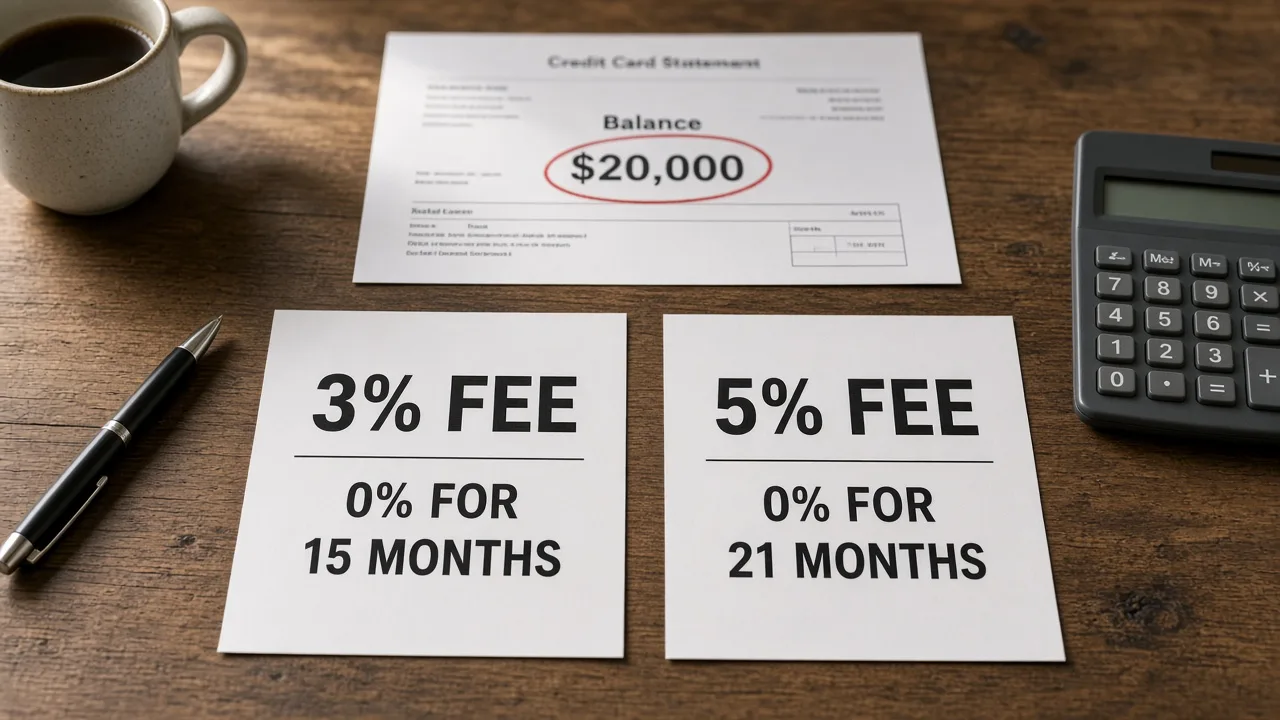
If you owe $20,000 at 29% APR and pay about $1,000 a month, a 0% balance transfer can look like an easy win. A reader in that spot recently asked whether to move the balance or keep paying the high-rate card. The real question is whether the transfer fee, the promo length, and the rate after 0% ends still beat staying put. Below we run the same $20,000 three ways with example terms—not an offer from any issuer.
What a balance transfer really costs
You usually pay a balance transfer fee up front, added to the transferred balance; the CFPB’s guide on consolidating card debt says the fee “is usually a certain percentage of the amount you transfer or a fixed amount, whichever is more,” and that the promotional rate “lasts for a limited time.” The 3% / 5% fees and 15- / 21-month windows below are example terms. When the promo ends, the regular APR hits whatever is left. The CFPB explains promotional financing and contrasts true 0% offers with deferred interest, where missing the deadline can add interest back to the date of purchase.
You also need a limit that covers balance + fee. The same CFPB guide warns that consolidating “may end up costing you more in fees and rising interest rates” than paying your old debts, so compare total cost, not the teaser rate alone. Run your numbers in our credit card payoff calculator before you apply.
The same $20,000, three ways
We modeled $20,000 at 29% APR, $1,000/month, no new charges. Interest each month is balance × APR ÷ 12, rounded to cents, before payment—the same method as our calculators. After 0% ends, the rate is 29%, equal to the reader’s current card.
| Path | Months | Interest | Fee | Total cost |
|---|---|---|---|---|
| A — Stay at 29% ($1,000/mo) | 28 | $7,656.71 | $0 | $7,656.71 |
| B — 3% fee, 0% for 15 months ($1,000/mo) | 22 | $490.41 | $600 | $1,090.41 |
| C — 5% fee, 0% for 21 months ($1,000/mo) | 21 | $0.00 | $1,000 | $1,000.00 |
Path B starts at $20,600 after the 3% fee. Path C starts at $21,000 after 5%. The 3% / 5% fees and 15- / 21-month promos are illustrative terms only, not a quote from a bank.
| Month | Stay at 29% ($1,000/mo) balance | 3% fee, 0% for 15 months ($1,000/mo) balance | 5% fee, 0% for 21 months ($1,000/mo) balance |
|---|---|---|---|
| 0 | $20,000.00 | $20,600.00 | $21,000.00 |
| 1 | $19,483.33 | $19,600.00 | $20,000.00 |
| 2 | $18,954.18 | $18,600.00 | $19,000.00 |
| 3 | $18,412.24 | $17,600.00 | $18,000.00 |
| 4 | $17,857.20 | $16,600.00 | $17,000.00 |
| 5 | $17,288.75 | $15,600.00 | $16,000.00 |
| 6 | $16,706.56 | $14,600.00 | $15,000.00 |
| 7 | $16,110.30 | $13,600.00 | $14,000.00 |
| 8 | $15,499.63 | $12,600.00 | $13,000.00 |
| 9 | $14,874.20 | $11,600.00 | $12,000.00 |
| 10 | $14,233.66 | $10,600.00 | $11,000.00 |
| 11 | $13,577.64 | $9,600.00 | $10,000.00 |
| 12 | $12,905.77 | $8,600.00 | $9,000.00 |
| 13 | $12,217.66 | $7,600.00 | $8,000.00 |
| 14 | $11,512.92 | $6,600.00 | $7,000.00 |
| 15 | $10,791.15 | $5,600.00 | $6,000.00 |
| 16 | $10,051.94 | $4,735.33 | $5,000.00 |
| 17 | $9,294.86 | $3,849.77 | $4,000.00 |
| 18 | $8,519.49 | $2,942.81 | $3,000.00 |
| 19 | $7,725.38 | $2,013.93 | $2,000.00 |
| 20 | $6,912.08 | $1,062.60 | $1,000.00 |
| 21 | $6,079.12 | $88.28 | $0.00 |
| 22 | $5,226.03 | $0.00 | $0.00 |
| 23 | $4,352.33 | $0.00 | $0.00 |
| 24 | $3,457.51 | $0.00 | $0.00 |
| 25 | $2,541.07 | $0.00 | $0.00 |
| 26 | $1,602.48 | $0.00 | $0.00 |
| 27 | $641.21 | $0.00 | $0.00 |
| 28 | $0.00 | $0.00 | $0.00 |
Why the 5% card won here
At $1,000 a month, path C’s longer 0% window beats path B’s lower fee, even though C costs $400 more up front. Path B pays down $15,000 during 15 interest-free months and leaves $5,600 when 0% ends; that tail at 29% adds $490.41 interest on top of the $600 fee. Path C uses all 21 months at 0% to clear $21,000—$1,000 total cost, fee only.
Path A still costs $7,656.71 in interest, so both transfers win here—but not in fee-percent order. Weighing a transfer against a debt management plan or consolidation loan? Compare total cost through payoff, not year one.
The payment that makes the 3% card win
Path B wins when you clear inside the promo: $20,600 ÷ 15 ≈ $1,373.34/month. At that payment, B finishes in 15 months ($600 cost), C in 16 ($1,000 fee), A in 19 ($4,949.31 interest). If $1,373.34 is not sustainable, the 15-month promo on the 3% offer is the risk—not the fee alone. The minimum payment calculator shows how a lower payment stretches interest if you stay on the old card.
Zero interest vs deferred interest
True 0% transfer promos charge no interest during the window if you pay on time; after that, interest applies only to what is left at the go-to APR. Deferred interest is stricter: if you miss the deadline, the CFPB says “interest going back to the date of the purchase will be added on top of the remaining balance.” The CFPB promotional financing article also warns that when a card carries other balances, “any amount above your minimum payment will usually be applied to the balance with the higher interest rate”—you can ask the issuer to apply extra payments to the promo balance, so check allocation rules on your disclosure.
Before you apply
Use this checklist with any offer you are considering:
- Fee in dollars, not just percent: on $20,000, 3% is $600 and 5% is $1,000.
- Promo end date on your statement and a calendar reminder before it hits.
- Post-promo APR on the disclosure—not the teaser—and whether it could match your current 29% card.
- Credit limit covers balance + fee with headroom; declines and partial transfers happen.
- Stop new charges on the old card (and avoid running up the transfer card) so you are not paying two balances.
- Payment plan: aim for (balance + fee) ÷ promo months, or a higher fixed payment you can keep until $0.
Compare paths with our debt consolidation calculator and the home calculator. Promotional terms change often; your issuer’s Schumer box beats any blog example.
See your debt-free date
Enter your debts and compare snowball and avalanche in under a minute.