
How to pay off holiday credit card debt before it sticks
Updated 18 Nov 2026
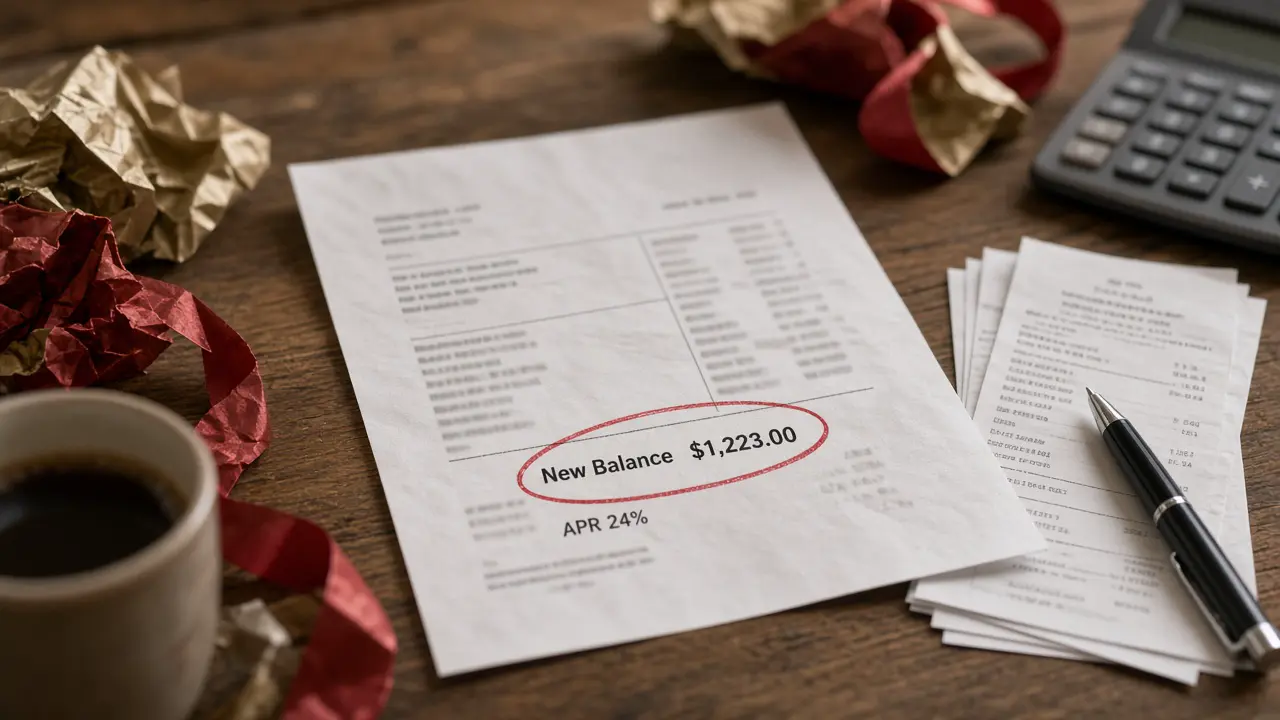
Holiday spending often lands on credit cards and buy-now-pay-later plans. A few minimum payments later, the balance can still be there when the next season starts. If you are wondering how to pay off holiday debt, the fix is not a secret formula—it is choosing a payment you can sustain and stopping new charges on the card you are paying down.
The question in one line
Survey data show how common that hangover is. A LendingTree survey (December 2025, n=2,032) found 37% of respondents took on holiday debt averaging $1,223; 63% expected three or more months to repay; 41% of those with holiday debt were still paying off the previous year’s; 40% were paying 20%+ APR; 62% used credit cards and 35% used BNPL. Credit Karma (September–October 2026, n=1,025) reported 34% entering the season with card debt and 43% worried about carrying a balance into the new year. A TSG/ETA study (September 2026, n=1,099) found 33% may take on holiday debt, up from 19% in 2025. Those are survey findings, not forecasts for your wallet—but they explain why “minimum until spring” often becomes “minimum until next Christmas.”
What $1,223 costs at 24%
The Federal Reserve’s G.19 release tracks average credit card APRs; many holiday balances sit well above the all-accounts average. Below we use $1,223 (the LendingTree average) at 24% APR as an illustration only. Monthly interest is round(balance × APR ÷ 12, 2) added before each payment; we assume no new charges. The example minimum follows a common pattern—interest plus 1% of the balance, with a $25 floor—real issuers vary; check your statement.
| Payment | Months to $0 | Total interest |
|---|---|---|
| A — Minimum only | 94 | $1,332.99 |
| B — $110/month | 13 | $174.24 |
| C — $215/month | 7 | $88.47 |
| D — $420/month | 4 | $49.74 |
| Month | Minimum only (1% + interest, $25 floor) balance | Fixed $215/month balance |
|---|---|---|
| 0 | $1,223.00 | $1,223.00 |
| 1 | $1,210.77 | $1,032.46 |
| 2 | $1,198.66 | $838.11 |
| 3 | $1,186.67 | $639.87 |
| 4 | $1,174.80 | $437.67 |
| 5 | $1,163.05 | $231.42 |
| 6 | $1,151.42 | $21.05 |
| 7 | $1,139.91 | $0.00 |
| 8 | $1,128.51 | $0.00 |
| 9 | $1,117.22 | $0.00 |
| 10 | $1,106.05 | $0.00 |
| 11 | $1,094.99 | $0.00 |
| 12 | $1,084.04 | $0.00 |
| 13 | $1,073.20 | $0.00 |
| 14 | $1,062.47 | $0.00 |
| 15 | $1,051.85 | $0.00 |
| 16 | $1,041.33 | $0.00 |
| 17 | $1,030.92 | $0.00 |
| 18 | $1,020.61 | $0.00 |
| 19 | $1,010.40 | $0.00 |
| 20 | $1,000.30 | $0.00 |
| 21 | $990.30 | $0.00 |
| 22 | $980.40 | $0.00 |
| 23 | $970.60 | $0.00 |
| 24 | $960.89 | $0.00 |
| 25 | $951.28 | $0.00 |
| 26 | $941.77 | $0.00 |
| 27 | $932.35 | $0.00 |
| 28 | $923.03 | $0.00 |
| 29 | $913.80 | $0.00 |
| 30 | $904.66 | $0.00 |
| 31 | $895.61 | $0.00 |
| 32 | $886.65 | $0.00 |
| 33 | $877.78 | $0.00 |
| 34 | $869.00 | $0.00 |
| 35 | $860.31 | $0.00 |
| 36 | $851.71 | $0.00 |
| 37 | $843.19 | $0.00 |
| 38 | $834.76 | $0.00 |
| 39 | $826.41 | $0.00 |
| 40 | $817.94 | $0.00 |
| 41 | $809.30 | $0.00 |
| 42 | $800.49 | $0.00 |
| 43 | $791.50 | $0.00 |
| 44 | $782.33 | $0.00 |
| 45 | $772.98 | $0.00 |
| 46 | $763.44 | $0.00 |
| 47 | $753.71 | $0.00 |
| 48 | $743.78 | $0.00 |
| 49 | $733.66 | $0.00 |
| 50 | $723.33 | $0.00 |
| 51 | $712.80 | $0.00 |
| 52 | $702.06 | $0.00 |
| 53 | $691.10 | $0.00 |
| 54 | $679.92 | $0.00 |
| 55 | $668.52 | $0.00 |
| 56 | $656.89 | $0.00 |
| 57 | $645.03 | $0.00 |
| 58 | $632.93 | $0.00 |
| 59 | $620.59 | $0.00 |
| 60 | $608.00 | $0.00 |
| 61 | $595.16 | $0.00 |
| 62 | $582.06 | $0.00 |
| 63 | $568.70 | $0.00 |
| 64 | $555.07 | $0.00 |
| 65 | $541.17 | $0.00 |
| 66 | $526.99 | $0.00 |
| 67 | $512.53 | $0.00 |
| 68 | $497.78 | $0.00 |
| 69 | $482.74 | $0.00 |
| 70 | $467.39 | $0.00 |
| 71 | $451.74 | $0.00 |
| 72 | $435.77 | $0.00 |
| 73 | $419.49 | $0.00 |
| 74 | $402.88 | $0.00 |
| 75 | $385.94 | $0.00 |
| 76 | $368.66 | $0.00 |
| 77 | $351.03 | $0.00 |
| 78 | $333.05 | $0.00 |
| 79 | $314.71 | $0.00 |
| 80 | $296.00 | $0.00 |
| 81 | $276.92 | $0.00 |
| 82 | $257.46 | $0.00 |
| 83 | $237.61 | $0.00 |
| 84 | $217.36 | $0.00 |
| 85 | $196.71 | $0.00 |
| 86 | $175.64 | $0.00 |
| 87 | $154.15 | $0.00 |
| 88 | $132.23 | $0.00 |
| 89 | $109.87 | $0.00 |
| 90 | $87.07 | $0.00 |
| 91 | $63.81 | $0.00 |
| 92 | $40.09 | $0.00 |
| 93 | $15.89 | $0.00 |
| 94 | $0.00 | $0.00 |
Headline: Paying $215 instead of the minimum saves $1,244.52 in interest and 87 months on this example balance.
Run your own numbers in our credit card payoff calculator or minimum payment calculator. If you are still on minimums, see how long that stretches the balance on the Discover minimum payment calculator or the debt budget calculator for a fixed payment you can afford.
Why the minimum is a trap
On path A, total interest ($1,332.99) exceeds the original $1,223 balance because most early payments mostly replace what interest added. We covered that mechanics in why minimum payments barely move your balance—the holiday version is the same math on a smaller starting balance, stretched across years if you only pay the minimum.
Pick a payoff date, then a payment
Divide what you owe by the number of months you want debt-free—that is your target payment before interest quirks. On $1,223, rough targets:
- 4 months → about $420/month (path D)
- 7 months → about $215/month (path C)
- 13 months → about $110/month (path B)
Pick the highest payment that still leaves room for rent, food, and an emergency buffer—not the lowest number on the statement. If $215 fits, path C clears the card by mid-summer on this schedule; if only $110 fits, path B still beats minimum-only by a wide margin.
If you also used buy now, pay later
BNPL plans often have fixed installments and late fees if you miss one. Pay those installments on time first so you do not stack penalties, then send every spare dollar to the highest-rate revolving balance. Read each BNPL agreement for due dates, deferred interest, and what happens if you return a purchase—terms differ and we do not name providers here.
If last year’s balance is still there
When old holiday debt and new charges sit on different cards, list every balance with its APR and minimum in the home snowball calculator or compare debt avalanche vs snowball strategies. Avalanche saves the most interest; snowball can motivate you by clearing small wins first. Either beats paying minimums on everything.
A January plan
Use this checklist with your real statements:
- Stop new charges on the card you are attacking (use cash or debit for essentials if you must).
- List every holiday balance with rate, minimum, and due date.
- Set autopay above the minimum for at least the target payment you chose—even $25 extra helps.
- Call the issuer about a lower rate or hardship program if your budget is tight; the CFPB notes that new borrowing to pay old debt rarely works unless spending changes.
- Consider a balance transfer only if the fee and promo window fit your payment—see is a balance transfer worth it.
- Nonprofit credit counseling may help if you owe on several accounts; the CFPB explains credit counseling and how to find a reputable agency.
Not financial advice.
See your debt-free date
Enter your debts and compare snowball and avalanche in under a minute.