
Should you use savings to pay off credit card debt?
Updated 18 Nov 2026
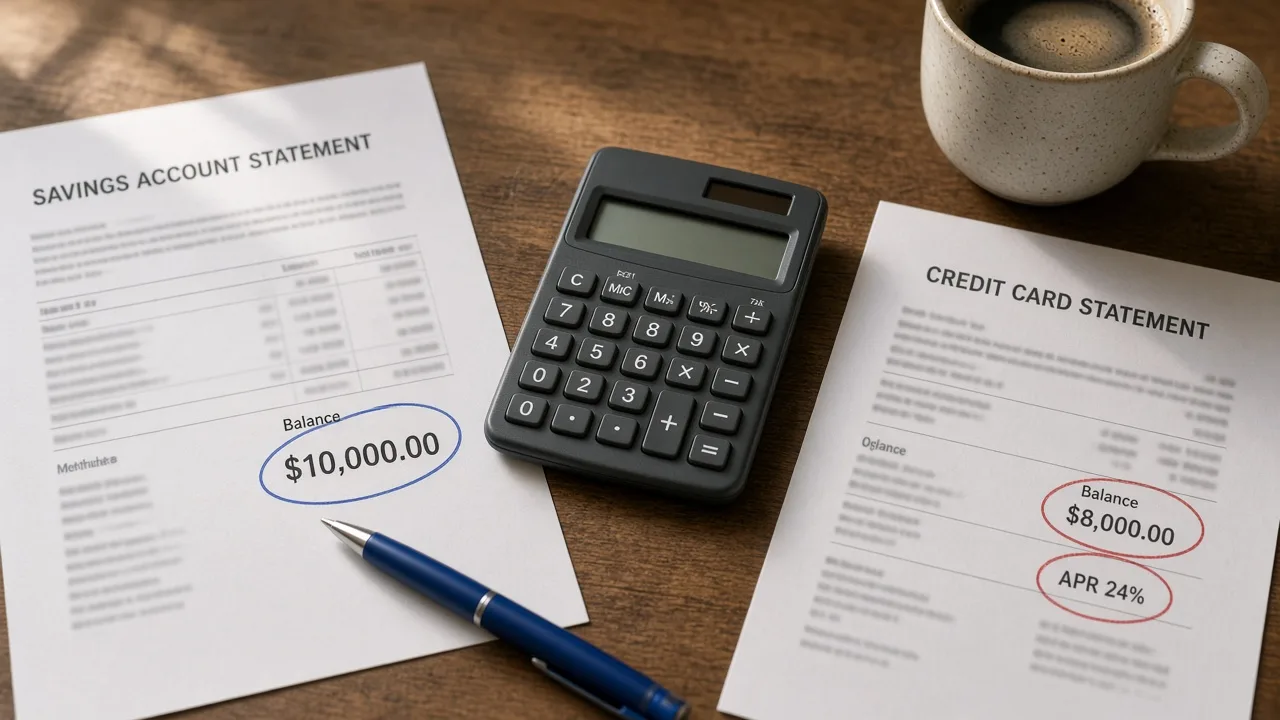
Readers often ask whether to use savings to pay off credit card debt, keep cash for emergencies, or split the difference. The trade-off is not philosophical: savings earn far less than revolving card interest costs, but draining every dollar can leave you with no cushion when a bill hits. Below we run the same $8,000 balance and $10,000 in savings three ways with example rates—not an offer from any bank.
The question in one line
If your savings account pays about 4% a year and your card charges about 24% APR, every dollar sitting in savings while the card balance stays high is effectively choosing a small credit over a large one. The Federal Reserve’s G.19 release shows that average bank card interest rates have been in that ballpark recently; savings yields move with the market and may be higher or lower than 4% today. The gap still favors paying down expensive debt when you can do it safely.
Three ways to handle $8,000
We modeled $8,000 on a card at 24% APR, $10,000 in savings earning 4% credited monthly, and $400 available each month for debt or savings. No new charges. Each month, savings interest is round(balance × 4% ÷ 12, 2) added to savings; card interest is round(balance × 24% ÷ 12, 2) added before the $400 payment. After the card hits $0, the full $400 (plus any leftover from the final payment) goes to savings. We compare outcomes at month 26, when path A clears the card.
| Path | Months | Card interest | Savings interest | Savings at mo 26 |
|---|---|---|---|---|
| A — Keep savings | 26 | $2,318.96 | $903.77 | $10,984.81 |
| B — Pay $7,000 | 3 | $37.05 | $629.42 | $12,992.37 |
| C — Pay $8,000 | 0 | $0.00 | $625.88 | $13,025.88 |
Path B starts with $1,000 on the card after the lump sum; path C starts with $0 on the card and $2,000 in savings. The chart shows card balance for A and B through month 26 (path C is already at $0).
| Month | Keep all savings ($400/mo) balance | Pay $7,000 from savings ($400/mo) balance |
|---|---|---|
| 0 | $8,000.00 | $1,000.00 |
| 1 | $7,760.00 | $620.00 |
| 2 | $7,515.20 | $232.40 |
| 3 | $7,265.50 | $0.00 |
| 4 | $7,010.81 | $0.00 |
| 5 | $6,751.03 | $0.00 |
| 6 | $6,486.05 | $0.00 |
| 7 | $6,215.77 | $0.00 |
| 8 | $5,940.09 | $0.00 |
| 9 | $5,658.89 | $0.00 |
| 10 | $5,372.07 | $0.00 |
| 11 | $5,079.51 | $0.00 |
| 12 | $4,781.10 | $0.00 |
| 13 | $4,476.72 | $0.00 |
| 14 | $4,166.25 | $0.00 |
| 15 | $3,849.58 | $0.00 |
| 16 | $3,526.57 | $0.00 |
| 17 | $3,197.10 | $0.00 |
| 18 | $2,861.04 | $0.00 |
| 19 | $2,518.26 | $0.00 |
| 20 | $2,168.63 | $0.00 |
| 21 | $1,812.00 | $0.00 |
| 22 | $1,448.24 | $0.00 |
| 23 | $1,077.20 | $0.00 |
| 24 | $698.74 | $0.00 |
| 25 | $312.71 | $0.00 |
| 26 | $0.00 | $0.00 |
Headline: Leaving $10,000 in savings while paying $400/month costs $2,007.56 in net worth at month 26 versus paying $7,000 toward the card and keeping a $3,000 cushion. Draining savings down to $2,000 instead of $3,000 adds only $33.51 more—because the 24% card cost swamps the 4% you earn on the extra $1,000 left in savings.
Run your balances in our credit card payoff calculator before you move money.
Why the cushion is nearly free
Path B pays $37.05 in card interest over 3 months, then sends $400/month to savings for the rest of the 26 months. Path A pays $2,318.96 in card interest and earns $903.77 on savings over the same window—still $2,007.56 behind path B at month 26. Path C saves the last $33.51 of card interest but gives up $1,000 of cushion and slightly lower savings interest on a smaller balance early on. The SEC’s compound interest calculator shows how small yield differences matter; here the spread between 4% and 24% dominates.
When keeping the savings makes sense
Keeping a larger cash pile can still be rational:
- You have a 0% promotional rate you can clear before it ends—see our post on whether a balance transfer is worth it for that math, not this savings-versus-payoff case.
- Income is unstable and missing a payment would hurt more than extra interest.
- You have no other way to cover a real emergency (not a sale, a true must-pay bill).
- You need the cash soon for rent, medical care, or another deadline.
If you cannot afford even the minimum, call your issuer before you miss payments. Our guide on how to ask for a credit card hardship program covers what to say and what to write down.
How big a cushion
There is no single correct number. A practical starting point is one month of essential expenses in cash you will not touch for discretionary spending—not a rule, but a floor many households use while attacking debt. The CFPB’s Building your savings? Start with small goals. booklet and its guide to building an emergency fund both stress starting with a small, reachable goal and growing from there. Keep that cushion in an account separate from everyday spending so it is still there when you need it.
Before you move the money
Use this checklist with your real statement numbers:
- Confirm the card APR and the savings rate you actually earn (after any tiers or limits).
- Keep the cushion in a separate account so it does not drift into daily spending.
- Stop new charges on the card you are paying down.
- Redirect the old card payment to rebuild savings on autopay once the balance is $0.
- Run your own numbers on the savings vs debt payoff calculator, the home calculator, or the minimum payment calculator if you are still deciding on payment size. Compare your statement minimum with the Citi minimum payment calculator or American Express minimum payment calculator before you pick a lump-sum amount.
Example 24% and 4% rates illustrate the trade-off; your issuer’s disclosure and your savings account terms beat any blog scenario.
See your debt-free date
Enter your debts and compare snowball and avalanche in under a minute.