
Should you use a 401(k) loan to pay off credit card debt?
Updated 3 Nov 2026
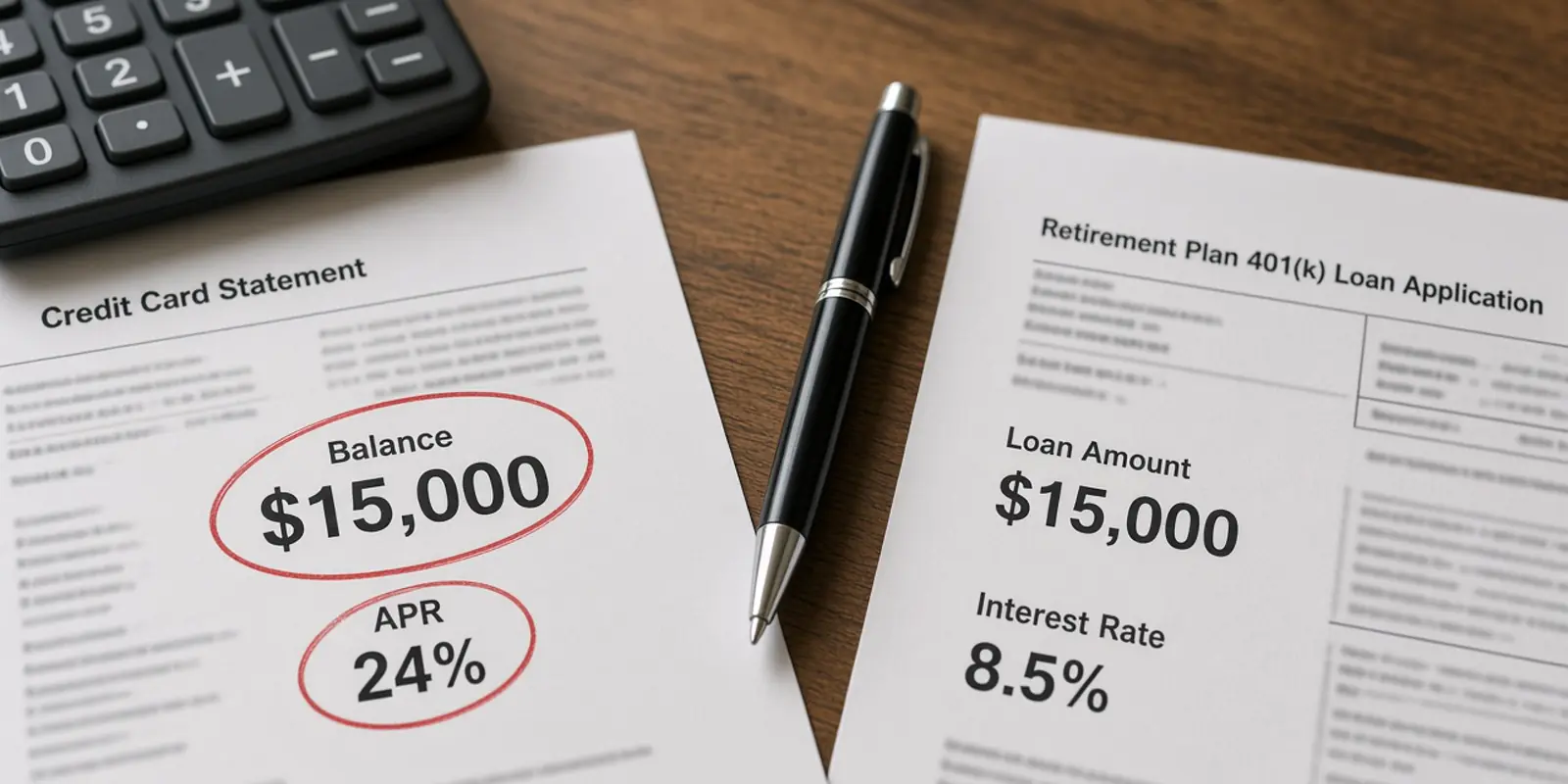
Readers often ask whether to borrow from a 401(k) to pay off credit card debt when the card rate is high and the retirement balance looks like a lifeline. You may pay yourself interest instead of a bank, but borrowed money is out of the market, repayments are after-tax, and leaving your job can leave a loan balance due—often as a plan loan offset you may be able to roll over if you act by the deadline. Below we run $15,000 and $500/month two ways with example rates—not a quote from any plan.
The question in one line
The Federal Reserve’s G.19 release (August 2026) puts average bank card APRs at 21.19% on all accounts and 22.36% on accounts assessed interest—well above typical plan loan rates (we use 8.5% below as an illustration only). Whether a 401(k) loan is smart still depends on job stability, whether you stop new charges, and what cheaper options you have first.
Same $15,000, two ways
We modeled $15,000 at 24% APR on a card versus a $15,000 plan loan at 8.5%, with $500 each month and no new charges. Interest is round(balance × APR ÷ 12, 2) before each payment—the same method as our credit card payoff calculator. By law, the maximum is generally the lesser of 50% of your vested balance or $50,000, with an IRS $10,000 exception when half of your vested balance is below $10,000—your plan document sets the rate and any stricter cap.
| Path | Months | Interest | Who receives it | 401(k) slice at month 47 |
|---|---|---|---|---|
| A — Keep paying the card | 47 | $8,136.53 | Card issuer | $19,715.77 |
| B — 401(k) loan | 34 | $1,922.83 | Your own account | $26,947.44 |
Path B clears the debt 13 months sooner. At month 47, a $15,000 slice growing at 7% a year (monthly compounding, example only) is $19,715.77 under A versus $26,947.44 under B—$7,231.67 ahead on paper for the loan path.
| Month | Keep paying the card ($500/mo) balance | 401(k) loan ($500/mo) balance |
|---|---|---|
| 0 | $15,000.00 | $15,000.00 |
| 1 | $14,800.00 | $14,606.25 |
| 2 | $14,596.00 | $14,209.71 |
| 3 | $14,387.92 | $13,810.36 |
| 4 | $14,175.68 | $13,408.18 |
| 5 | $13,959.19 | $13,003.15 |
| 6 | $13,738.37 | $12,595.26 |
| 7 | $13,513.14 | $12,184.48 |
| 8 | $13,283.40 | $11,770.79 |
| 9 | $13,049.07 | $11,354.17 |
| 10 | $12,810.05 | $10,934.60 |
| 11 | $12,566.25 | $10,512.05 |
| 12 | $12,317.58 | $10,086.51 |
| 13 | $12,063.93 | $9,657.96 |
| 14 | $11,805.21 | $9,226.37 |
| 15 | $11,541.31 | $8,791.72 |
| 16 | $11,272.14 | $8,353.99 |
| 17 | $10,997.58 | $7,913.16 |
| 18 | $10,717.53 | $7,469.21 |
| 19 | $10,431.88 | $7,022.12 |
| 20 | $10,140.52 | $6,571.86 |
| 21 | $9,843.33 | $6,118.41 |
| 22 | $9,540.20 | $5,661.75 |
| 23 | $9,231.00 | $5,201.85 |
| 24 | $8,915.62 | $4,738.70 |
| 25 | $8,593.93 | $4,272.27 |
| 26 | $8,265.81 | $3,802.53 |
| 27 | $7,931.13 | $3,329.46 |
| 28 | $7,589.75 | $2,853.04 |
| 29 | $7,241.54 | $2,373.25 |
| 30 | $6,886.37 | $1,890.06 |
| 31 | $6,524.10 | $1,403.45 |
| 32 | $6,154.58 | $913.39 |
| 33 | $5,777.67 | $419.86 |
| 34 | $5,393.22 | $0.00 |
| 35 | $5,001.08 | $0.00 |
| 36 | $4,601.10 | $0.00 |
| 37 | $4,193.12 | $0.00 |
| 38 | $3,776.98 | $0.00 |
| 39 | $3,352.52 | $0.00 |
| 40 | $2,919.57 | $0.00 |
| 41 | $2,477.96 | $0.00 |
| 42 | $2,027.52 | $0.00 |
| 43 | $1,568.07 | $0.00 |
| 44 | $1,099.43 | $0.00 |
| 45 | $621.42 | $0.00 |
| 46 | $133.85 | $0.00 |
| 47 | $0.00 | $0.00 |
Headline: The loan wins on paper only if you keep the job and do not run the cards back up.
What the loan really costs
Loan interest often returns to your account, but the $15,000 you borrow is not invested while it sits on the card at 0% from the market’s point of view. Each $500 repayment is after-tax cash from your paycheck, even though the dollars land back in the plan. Lost market growth on the borrowed slice is part of the real cost—our 7% growth rate is an assumption, not a forecast.
The job-loss risk
If you leave your employer, many plans treat an unpaid loan as a plan loan offset—a taxable distribution unless you roll it over. The IRS retirement plan loans FAQ notes you generally have until the due date of your tax return for that year, including extensions, to complete the rollover. See also the IRS loan overview and plan loan rules. In path B, after 12 months the balance is $10,086.51; if you do not roll over that offset, an example 22% bracket plus 10% additional tax (state ignored) is about $3,227.68—not tax advice; read your plan’s default terms.
Why cashing out is worse
Taking a withdrawal instead of a loan usually means tax and penalties up front. To net $15,000 after an example 22% income tax and 10% additional tax, you would need to withdraw about $22,058.82, with roughly $7,058.82 lost to tax and penalty—far worse than loan interest at 8.5%.
When it can make sense / when it doesn't
A plan loan might fit when:
- Your job is stable and you understand what happens if you leave.
- Cards are closed or frozen and you have fixed the spending that built the debt.
- You have no cheaper path, such as a balance transfer worth the fee math or credit counseling / DMP options.
It often does not fit when employment is shaky, you might run cards back up, or you would miss an employer match while repaying. The CFPB notes that new debt to pay old debt may be kicking the can down the road unless spending changes. See also cash savings vs paying cards.
Before you borrow
Use this checklist with your real numbers:
- Read your plan’s loan terms: rate, fees, max, how many loans at once, and what happens if you terminate.
- Keep contributing enough to capture any employer match if you can.
- Stop new card charges on the accounts you pay off with the loan proceeds.
- Compare alternatives in our debt consolidation calculator and on the home calculator.
- Run your own numbers on the 401(k) loan vs keep paying debt calculator before you sign—not tax advice; confirm plan rules with your administrator.
Not financial advice.
See your debt-free date
Enter your debts and compare snowball and avalanche in under a minute.