
Lost your job? A 30-day plan for credit card debt
Updated 18 Nov 2026
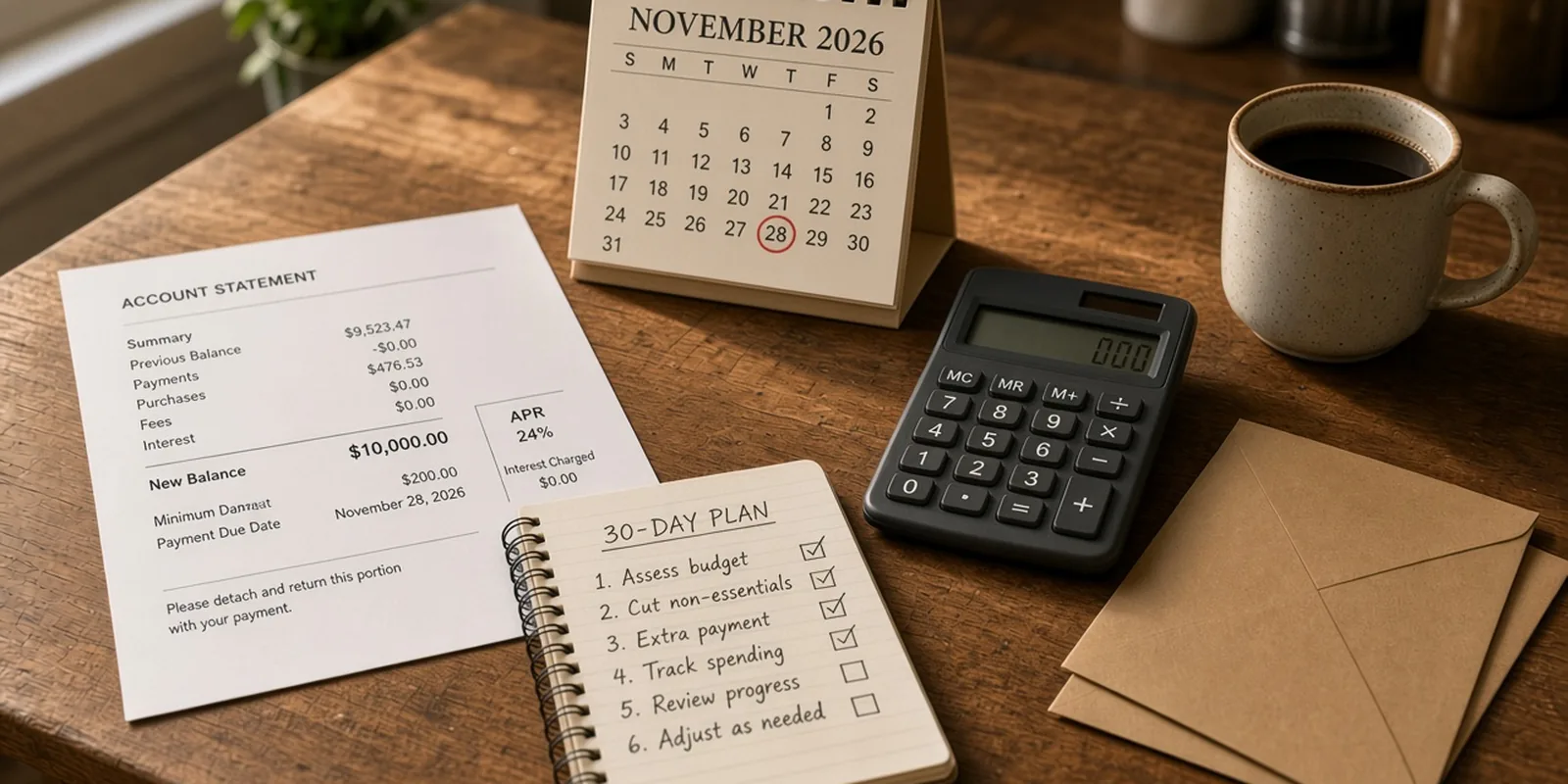
Losing a job can turn a manageable card balance into a cash-flow emergency in weeks. If you are asking what to do with credit card debt after a job loss, start by protecting housing and food, calling issuers before a payment is late, and picking a payment you can keep.
The question in one line
The CFPB's unexpected job loss guide says to file for unemployment, take care of rent or a mortgage, then contact lenders and ask for more affordable options. The CFPB also says to act right away if you cannot pay a card bill — many issuers will work with you if you explain the emergency, what you can pay, and when you could resume normal payments. That call is the conversation in how to ask for a credit card hardship program. This post is the 30-day triage around it.
What $10,000 costs if you pause
The Federal Reserve's G.19 release (last update 6 Nov 2026) shows commercial-bank credit card APRs of 21.19% for all accounts and 22.36% for accounts assessed interest (2026 Q3 / August, preliminary). Many people who carry a balance pay more than the all-accounts average. We use $10,000 at 24% APR as an illustration only, not a quote of your statement.
Monthly interest is round(balance × APR ÷ 12, 2) added before each payment, with no new charges. The example minimum is interest plus 1% of the balance, with a $25 floor. On $10,000 at 24%, the first-month minimum is $300. Real issuers vary; check your statement.
| Path | Months to $0 | Total interest |
|---|---|---|
| A — Keep paying $300/month | 56 | $6,644.21 |
| B — 3-month $0 pause, then $300 | 66 | $8,621.93 |
| C — 3-month $0 pause, then $400 | 42 | $5,277.51 |
| D — Minimum only | 303 | $18,887.07 |
| Month | Keep paying $300/month balance | Keep paying $400/month balance |
|---|---|---|
| 0 | $10,000.00 | $10,000.00 |
| 1 | $9,900.00 | $9,800.00 |
| 2 | $9,798.00 | $9,596.00 |
| 3 | $9,693.96 | $9,387.92 |
| 4 | $9,587.84 | $9,175.68 |
| 5 | $9,479.60 | $8,959.19 |
| 6 | $9,369.19 | $8,738.37 |
| 7 | $9,256.57 | $8,513.14 |
| 8 | $9,141.70 | $8,283.40 |
| 9 | $9,024.53 | $8,049.07 |
| 10 | $8,905.02 | $7,810.05 |
| 11 | $8,783.12 | $7,566.25 |
| 12 | $8,658.78 | $7,317.58 |
| 13 | $8,531.96 | $7,063.93 |
| 14 | $8,402.60 | $6,805.21 |
| 15 | $8,270.65 | $6,541.31 |
| 16 | $8,136.06 | $6,272.14 |
| 17 | $7,998.78 | $5,997.58 |
| 18 | $7,858.76 | $5,717.53 |
| 19 | $7,715.94 | $5,431.88 |
| 20 | $7,570.26 | $5,140.52 |
| 21 | $7,421.67 | $4,843.33 |
| 22 | $7,270.10 | $4,540.20 |
| 23 | $7,115.50 | $4,231.00 |
| 24 | $6,957.81 | $3,915.62 |
| 25 | $6,796.97 | $3,593.93 |
| 26 | $6,632.91 | $3,265.81 |
| 27 | $6,465.57 | $2,931.13 |
| 28 | $6,294.88 | $2,589.75 |
| 29 | $6,120.78 | $2,241.54 |
| 30 | $5,943.20 | $1,886.37 |
| 31 | $5,762.06 | $1,524.10 |
| 32 | $5,577.30 | $1,154.58 |
| 33 | $5,388.85 | $777.67 |
| 34 | $5,196.63 | $393.22 |
| 35 | $5,000.56 | $1.08 |
| 36 | $4,800.57 | $0.00 |
| 37 | $4,596.58 | $0.00 |
| 38 | $4,388.51 | $0.00 |
| 39 | $4,176.28 | $0.00 |
| 40 | $3,959.81 | $0.00 |
| 41 | $3,739.01 | $0.00 |
| 42 | $3,513.79 | $0.00 |
| 43 | $3,284.07 | $0.00 |
| 44 | $3,049.75 | $0.00 |
| 45 | $2,810.75 | $0.00 |
| 46 | $2,566.97 | $0.00 |
| 47 | $2,318.31 | $0.00 |
| 48 | $2,064.68 | $0.00 |
| 49 | $1,805.97 | $0.00 |
| 50 | $1,542.09 | $0.00 |
| 51 | $1,272.93 | $0.00 |
| 52 | $998.39 | $0.00 |
| 53 | $718.36 | $0.00 |
| 54 | $432.73 | $0.00 |
| 55 | $141.38 | $0.00 |
| 56 | $0.00 | $0.00 |
Headline: A three-month pause, then the same $300, costs $1,977.72 more and 10 extra months than keeping $300 going. The pause itself adds $612.08 (the balance grows to $10,612.08). If you later get to $400, path C still finishes 14 months sooner than never pausing at $300. Starting at $400 from day one is faster still — 36 months and $4,001.10 — which is why the chart compares a steady $300 and $400. Path D is the expensive default in why minimum payments barely move your balance.
Run your numbers in the credit card payoff calculator or the minimum payment calculator. If your budget only allows the statement minimum for now, model it with the Chase minimum payment calculator or Discover minimum payment calculator, then use the debt budget calculator to see what extra you can add when income returns.
The first 30 days
- File for unemployment in the state where you worked, even if you live elsewhere. It rarely replaces your full income and is usually taxable; start anyway. See the CFPB guide and USA.gov on how to apply.
- Protect housing and insurance. Call your mortgage servicer or landlord early, and look at health-coverage options.
- Stop new charges on the cards you already carry. Use cash or debit for essentials if you can.
- List every debt with its APR, minimum, and due date. If you have more than one card, use the home snowball calculator or compare avalanche vs snowball.
- Call each issuer before a payment is late. Say you lost your job, what you can pay, and when you hope to resume. Ask whether interest and fees continue and whether the account will be closed or frozen, and get the terms in writing. Do not assume you must miss a payment first.
- Review automatic payments so a due date does not empty a thinner checking account.
If you also have student loans, ask the servicer about a lower payment and check it in the student loan payoff calculator.
What not to reach for first
It is tempting to empty savings or take a retirement loan the week the paycheck stops. We already ran those trade-offs: using savings to pay off cards only makes sense if you leave a real cushion, and a 401(k) loan to pay off card debt can backfire if you are between jobs and the loan becomes due. The CFPB job-loss page makes the same point: retirement withdrawals can be taxable, and you cannot undo a distribution. Treat those as later options, not day-one moves.
Watch for debt-relief pitches that tell you to stop paying or promise to make the debt disappear. The CFPB warns that for-profit settlement companies may charge fees and tell you to cut off your issuer. If you need a plan across several cards, start with nonprofit credit counseling. If a debt-management plan is on the table, see our DMP vs consolidation loan numbers.
A 30-day checklist
- File for unemployment and note the first expected payment date.
- Write down rent or mortgage, utilities, food, insurance, and every card minimum.
- Call each issuer, ask for hardship or a temporary lower payment, and keep a written copy of anything you accept.
- Set the highest payment you can sustain, even if that is only the current minimum, and avoid a silent $0 pause unless the issuer agrees in writing.
- When income restarts, raise the payment if you can. In the example, going from $300 to $400 after a pause beats staying at $300.
- If the budget still does not close, talk to a nonprofit credit counselor before you skip payments.
Not financial advice.
See your debt-free date
Enter your debts and compare snowball and avalanche in under a minute.