
Pay off car loan or card first? $6,000 bonus both ways
Updated 12 Nov 2026
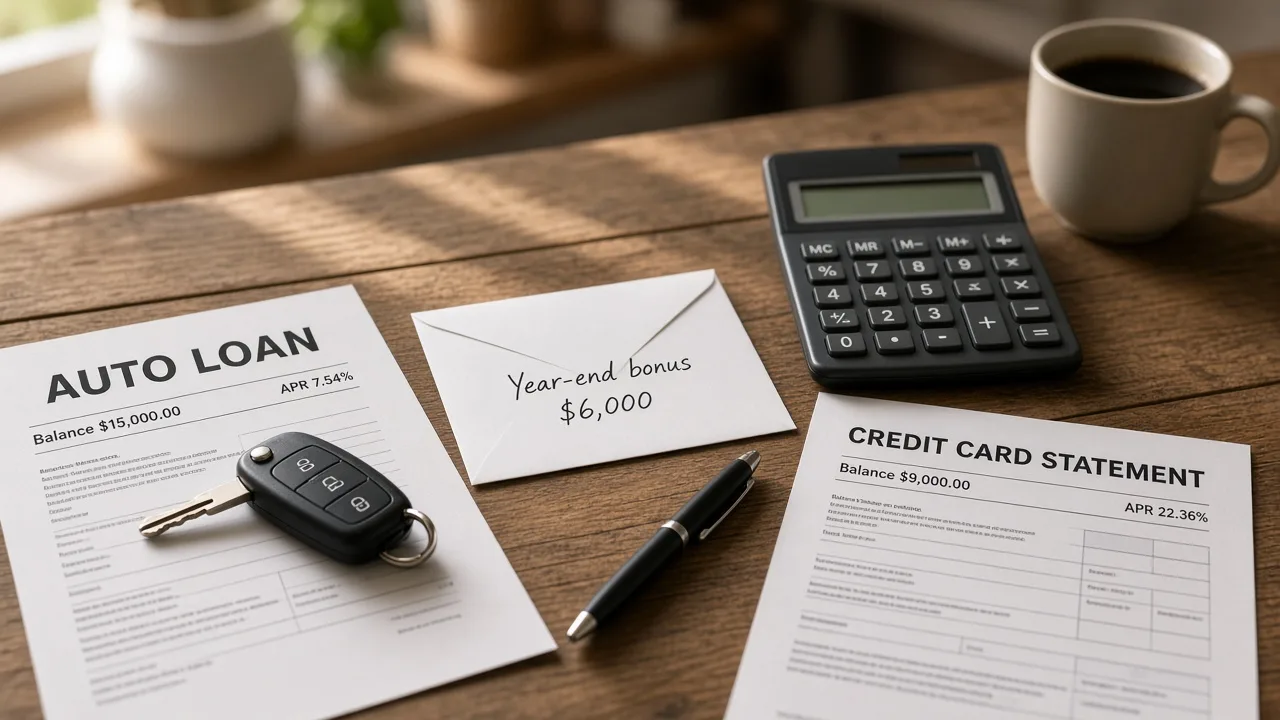
A year-end bonus, a tax refund or a small inheritance lands, and the same question shows up on Reddit every week: should I pay off my car loan or my credit card first? The car payment is bigger and feels heavier. The card balance is smaller and feels manageable. The math usually points the other way.
The question in one line
Send extra money to the debt with the highest interest rate, keep every other payment on time, and roll freed-up payments into what is left. The Federal Reserve's G.19 release (updated 6 November 2026) puts the average card rate for accounts assessed interest at 22.36% in 2026 Q3, against 7.54% for a 60-month new-car loan at a commercial bank. That gap is the whole story for most people. Experian gives the same general rule: card debt first, because it usually costs far more.
What a $6,000 bonus does each way
Our example uses averages, not an offer from any lender:
- Credit card: $9,000 at 22.36% APR, paying $300 a month
- Car loan: $15,000 at 7.54% APR, paying $400 a month
- Budget: $700 a month in total, and when one debt is paid off its payment rolls into the other
- Bonus: $6,000 after tax, with a small cash cushion already set aside
Interest is charged monthly at APR ÷ 12 and rounded to the cent.
| Plan | Card paid off | Car paid off | Debt-free | Total interest |
|---|---|---|---|---|
| No bonus | month 44 | month 43 | 44 months | $6,460.95 |
| $6,000 to the car | month 33 | month 25 | 33 months | $4,417.75 |
| $6,000 to the card | month 12 | month 29 | 29 months | $1,965.94 |
| Month | Bonus to the car (card stays $9,000, $300/mo) balance | Bonus to the card ($3,000 left, $300/mo) balance |
|---|---|---|
| 0 | $9,000.00 | $3,000.00 |
| 1 | $8,867.70 | $2,755.90 |
| 2 | $8,732.93 | $2,507.25 |
| 3 | $8,595.65 | $2,253.97 |
| 4 | $8,455.82 | $1,995.97 |
| 5 | $8,313.38 | $1,733.16 |
| 6 | $8,168.29 | $1,465.45 |
| 7 | $8,020.49 | $1,192.76 |
| 8 | $7,869.94 | $914.99 |
| 9 | $7,716.58 | $632.04 |
| 10 | $7,560.37 | $343.82 |
| 11 | $7,401.24 | $50.23 |
| 12 | $7,239.15 | $0.00 |
| 13 | $7,074.04 | $0.00 |
| 14 | $6,905.85 | $0.00 |
| 15 | $6,734.53 | $0.00 |
| 16 | $6,560.02 | $0.00 |
| 17 | $6,382.26 | $0.00 |
| 18 | $6,201.18 | $0.00 |
| 19 | $6,016.73 | $0.00 |
| 20 | $5,828.84 | $0.00 |
| 21 | $5,637.45 | $0.00 |
| 22 | $5,442.49 | $0.00 |
| 23 | $5,243.90 | $0.00 |
| 24 | $5,041.61 | $0.00 |
| 25 | $4,835.55 | $0.00 |
| 26 | $4,625.65 | $0.00 |
| 27 | $4,411.84 | $0.00 |
| 28 | $4,194.05 | $0.00 |
| 29 | $3,972.20 | $0.00 |
| 30 | $3,746.22 | $0.00 |
| 31 | $3,516.02 | $0.00 |
| 32 | $3,281.54 | $0.00 |
| 33 | $3,042.69 | $0.00 |
| 34 | $2,799.39 | $0.00 |
| 35 | $2,551.55 | $0.00 |
| 36 | $2,299.09 | $0.00 |
| 37 | $2,041.93 | $0.00 |
| 38 | $1,779.98 | $0.00 |
| 39 | $1,513.15 | $0.00 |
| 40 | $1,241.35 | $0.00 |
| 41 | $964.48 | $0.00 |
| 42 | $682.45 | $0.00 |
| 43 | $395.17 | $0.00 |
| 44 | $102.53 | $0.00 |
| 45 | $0.00 | $0.00 |
Headline: Putting the bonus on the card instead of the car saves $2,451.81 and makes you debt-free 4 months sooner. The chart shows the card balance only, at $300 a month before any rollover: from $3,000 it is gone in 12 months with $351.17 of interest; left at $9,000 it would take 45 months and $4,304.44.
Why the gap is so big: every dollar on the card stops costing about 22 cents a year, while a dollar on the car stops costing under 8 cents. The bigger monthly payment on the car does not change that. Once the card is gone in month 12, its $300 joins the car's $400, so the car still finishes by month 29.
When the car can come first
The rate rule has a few real exceptions:
- Your car loan rate is higher than your card rate. Some subprime auto loans charge more than a card, and a card on a true 0% promo is cheaper until the promo ends. Compare actual APRs from your statements, and see is a balance transfer worth it for what happens when a 0% rate expires.
- The car is almost paid off. If only one or two payments remain, clearing it frees the whole payment for the card. Experian also notes that a very small car balance can be worth clearing first for the motivation.
- You are behind on the car. Missed car payments can lead to repossession, and losing the car can cost you the income that pays everything else. Get current on the car before sending extra anywhere.
Before you pay a car loan off early, read the contract. NerdWallet says prepayment penalties are less common than they used to be, but some lenders still charge one, and Experian says they can reach 2% of the outstanding balance. If you are juggling several debts, the CFPB's guide on consolidating card debt also reminds you to compare total cost—not just monthly payment—before moving balances.
Do not spend the whole bonus
A bonus that goes entirely to debt can leave you putting the next car repair right back on the card. Keep a small cushion first, then send the rest to the highest rate. The CFPB's guide to building an emergency fund recommends starting with a reachable savings goal before putting every extra dollar toward debt. We ran that trade-off in should you use savings to pay off credit card debt.
If you have several cards and a car loan, the same idea scales: list every debt by rate and use the debt avalanche vs snowball comparison. If staying motivated matters more than the last dollar of interest, the debt snowball method clears the smallest balance first.
Run your own numbers
- Pull the balance, APR and payment from your latest card and car statements.
- Put the card into the credit card payoff calculator twice: once with the balance after your lump sum, once without.
- Do the same for the car in the car loan payoff calculator.
- Send the lump sum where it removes the higher rate, and set a reminder to roll the freed-up payment over the day that debt hits zero.
The car payment may be the bigger bill, but the card is usually the more expensive debt. Pay that one off first unless one of the exceptions above applies to you.
See your debt-free date
Enter your debts and compare snowball and avalanche in under a minute.